

Key Takeaways
Why tire pressure is a fuel economy issue
Most drivers think of tire inflation as a safety matter. It is also a fuel cost matter. When a tire runs below its recommended pressure, the contact patch between rubber and road widens. That wider contact generates more rolling resistance, meaning the engine has to work harder to move the vehicle the same distance. More engine work burns more fuel.
The U.S. Department of Energy has stated that for every 1 PSI drop in pressure across all four tires, fuel economy falls by roughly 0.2 percent. That sounds small, but tires commonly run 5 to 8 PSI below specification without triggering a warning light. At that point, the cumulative loss reaches 1 to 1.6 percent, which adds up over tens of thousands of miles. Paired with other overlooked costs, tire neglect is the kind of slow drain described in our guide to small spending leaks that families rarely notice until it compounds.
One correction many drivers make is to read the number printed on the tire sidewall and use that as the target. That number is the maximum pressure the tire can hold, not the recommended operating pressure. The correct number is on a sticker inside the driver's door jamb. Using the wrong figure can lead to both underinflation and overinflation, each of which carries its own efficiency and safety penalty.
How rotation fits into the efficiency picture
Tire rotation moves each tire to a different wheel position on a set schedule, typically every 5,000 to 7,500 miles or as specified in the vehicle owner's manual. The purpose is to even out tread wear. Front tires on a front-wheel-drive vehicle wear faster because they handle both steering and acceleration loads. Without rotation, the front tires wear thin while the rears remain relatively fresh, and the vehicle ends up riding on a mismatched set.
Uneven tread affects fuel economy because a tire with irregular or shallow tread does not roll as efficiently as one with even, adequate tread. The vehicle has to compensate, often through slightly more throttle input. Consistent rotation keeps all four tires in closer parity, which helps the drivetrain operate within its intended efficiency range.
Check all four tire pressures at least once a month and before any long drive.
Pressure can drop from temperature changes or slow leaks without any visible sign. Monthly checks catch the problem before it affects fuel economy or tire wear. A tire 6 PSI low can reduce efficiency by over 1 percent and accelerate uneven tread wear.
Use the door placard pressure specification, not the sidewall maximum.
The number molded into the tire sidewall is the maximum the tire can hold safely, which is typically higher than the pressure the vehicle manufacturer recommends for ride, handling, and fuel economy. Using the wrong figure leads to either over- or underinflation.
Follow the vehicle owner's manual rotation schedule rather than guessing.
Rotation intervals and patterns vary by drivetrain type. Front-wheel drive, rear-wheel drive, and all-wheel drive systems each have recommended rotation patterns that account for where wear concentrates. Skipping or misjudging the interval allows wear disparities to compound.
Inspect tires visually each time you fill up with fuel.
A visual check takes ten seconds and can catch a sidewall bulge, embedded screw, or unusual wear pattern before it becomes a blowout or a tread failure. Early detection keeps repair costs lower than emergency replacement.
Check tire pressure after significant temperature swings, not just on a fixed calendar date.
Pressure changes with temperature at a predictable rate. A cold snap of 20 degrees Fahrenheit can drop all four tires by approximately 2 PSI overnight. Waiting until the next scheduled check means driving on underinflated tires for days or weeks.
Tire condition also affects resale and total ownership costs. A vehicle presented with four evenly worn tires in good condition holds its value better than one showing uneven wear patterns, which signals to a buyer that maintenance was inconsistent. For a fuller picture of how maintenance decisions feed into long-term ownership costs, see the true cost of owning a car.
Seasonal pressure changes and when to check
Tire pressure is not static. Tires lose approximately 1 PSI for every 10-degree Fahrenheit drop in ambient temperature. A tire at the correct pressure in September can be 5 to 6 PSI low by December without a single slow leak. This makes autumn a particularly important time to check all four tires and the spare.
Checking pressure when the tires are cold, meaning the vehicle has been parked for at least three hours or driven fewer than one mile at low speed, produces the most accurate reading. Pressure checked after highway driving will read higher than the actual baseline because heat from friction temporarily expands the air inside. Adjust based on cold readings against the door placard specification.
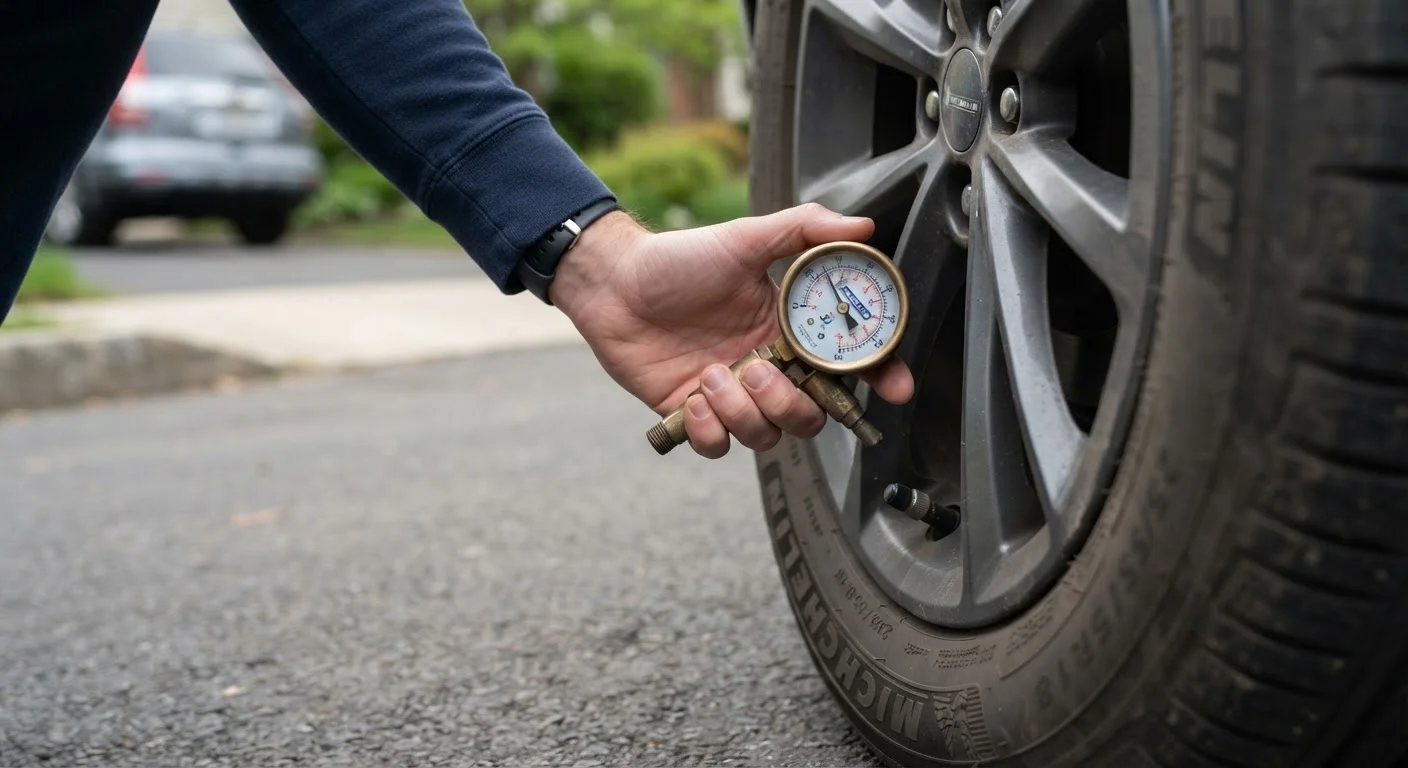
A quality digital pressure gauge costs a few dollars and takes less than two minutes to use. That is a small time investment compared to the cumulative fuel cost of driving on tires that are chronically 6 PSI low. For families planning longer drives, proper tire condition is also one of the less-discussed factors covered in what actually drives up road trip costs.
Putting it together with broader fuel habits
Tire care does not exist in isolation. It works alongside driving habits, load management, and vehicle condition to determine real-world fuel economy. A driver who maintains correct tire pressure but habitually accelerates hard and brakes late will still burn more fuel than necessary. Conversely, a smooth, consistent driver on chronically underinflated tires leaves efficiency on the table.
Fuel economy is a system. Tire pressure and rotation are two of the lower-cost, higher-impact variables within that system. For context on other habits that affect mileage, fuel economy myths that keep costing drivers money covers several widely held practices that do not perform as drivers expect. Families considering a vehicle change can also factor in how powertrain type affects long-run fuel expenses, as detailed in lifetime fuel and energy costs by powertrain.
Maintaining tires correctly does not require mechanical expertise. It requires a gauge, a few minutes each month, and knowing where to find the correct specification for your vehicle.