

Key Takeaways
Our Verdict
Cash envelopes and digital apps both give families a framework for controlling spending. Envelopes are concrete and low-tech, which helps people who struggle with card overspending. Apps handle the complexity of modern household finances, including automatic bill pay and multiple income streams, more efficiently. The right choice depends on where your family's spending tends to break down.
| Best for | Recommended |
|---|---|
| Families who frequently overspend on groceries, dining, or other discretionary categories | Cash envelope system |
| Households with irregular income, multiple accounts, or heavy card use | Digital budgeting app |
| Families new to budgeting who want a simple, visual starting point | Cash envelope system |
| Families who want detailed spending history and automatic category tracking | Digital budgeting app |
How each system works
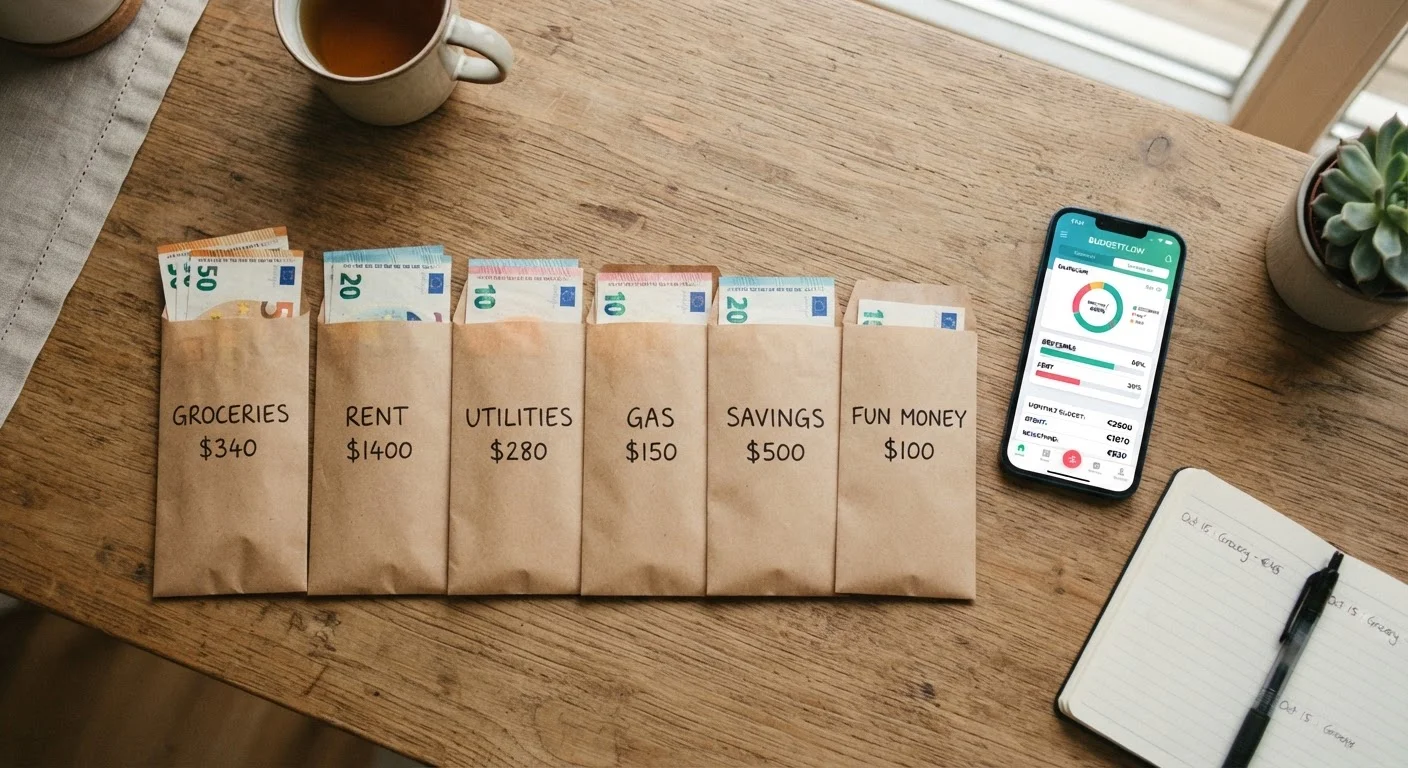
The cash envelope system divides your monthly budget into spending categories, and you put physical cash into a labeled envelope for each one. Groceries, gas, entertainment, eating out: each gets its own envelope. When the cash is gone, spending in that category stops until the next month. No math required mid-month, and no need to log in anywhere.
Digital budgeting apps connect to your bank accounts and credit cards, then automatically sort your transactions into categories. You set a spending limit for each category, and the app tells you how much remains. Some apps also track bills, savings goals, and debt payoff progress in the same place. If you want more context on how spending categories fit together, see how a household budget breaks down.
Where cash envelopes have an edge
The physical act of handing over cash is harder to ignore than a card swipe. Many people report spending less when they pay with cash because the loss feels immediate. For families who consistently go over budget on groceries or dining, a cash envelope can act as a hard stop that a digital warning cannot replicate.
Envelopes also work without a smartphone, a data plan, or any subscription fee. Setup takes about 30 minutes: write your categories, withdraw your budgeted cash, and you are running. For families just starting out, the simplicity of the system removes a lot of early friction. Starting a family budget from scratch pairs well with this approach because it walks through the same category-based thinking.
Start with your problem categories
Before choosing a system, look back at two or three months of bank statements and identify which categories go over budget most often. If you find two or three consistent culprits, cash envelopes for just those categories can make a noticeable difference without overhauling your entire approach.
Where digital apps have an edge
Cash cannot track a utility autopay or a subscription charge. If most of your spending happens by card or automatic transfer, envelopes only cover part of the picture. Apps see all of it: every transaction, every account, in one place.
Apps also store months of spending history, which makes it easier to spot patterns over time. You can see that restaurant spending always climbs in December, or that your grocery bill spikes when school starts. That data is hard to reconstruct from a pile of old envelopes. For families who want to run a structured monthly review, a monthly financial checkup outlines how to use that history effectively.
Irregular income is another place where apps win. If your paycheck varies each month, an app can adjust category limits based on what actually came in, rather than forcing you to pre-fill envelopes based on a figure that may not match reality.
| Cash envelopes | Digital budgeting app | |
|---|---|---|
| Cost | Free | Free to paid (varies by app) |
| Handles automatic payments | No | Yes |
| Tracks spending history | Only if you record manually | Automatic, months of data |
| Works without smartphone | Yes | Usually no |
| Physical spending friction | High (cash feels real) | Low (card use unchanged) |
| Setup time | 30 minutes | 1 to 2 hours for initial sync |
| Good for irregular income | Difficult | Manageable |
| Multi-account visibility | No | Yes |
Common pitfalls with both methods
The most common envelope problem is raiding one envelope to cover another. Moving grocery money to cover an impulse purchase defeats the system's purpose. A rule that forbids transfers between envelopes, with rare exceptions for genuine emergencies, is the usual fix.
Apps have their own failure mode: too many categories. When a budget has 25 line items, tracking becomes a chore that most people abandon within a few weeks. Keeping it to 10 or fewer categories is a practical way to stay with it. Overspending does not always come from a broken tool; sometimes the budget itself has gaps. Why families overspend even with a budget covers those gaps in detail.
The hybrid option
Some families use cash for the two or three categories where they consistently overspend, and let an app handle everything else. This approach is practical because it targets the actual problem without requiring cash for every purchase. A family that overspends on eating out but pays all other bills automatically might carry one dining envelope while tracking subscriptions, utilities, and savings goals digitally.
Whichever system you use, the underlying mechanics are the same: assign every dollar a purpose before you spend it, then track whether you followed through. If your family also carries debt, note that the budgeting tool you choose affects how much you can direct toward payoff each month. Balancing debt payoff and savings explains how to work both goals into a single budget.
This article is for general informational and educational purposes only and is not personalized financial advice. Consider consulting a qualified financial professional for guidance specific to your situation.