
Whole Foods vs. Processed Foods: What the Difference Actually Means for Your Diet

Key Takeaways
Option A
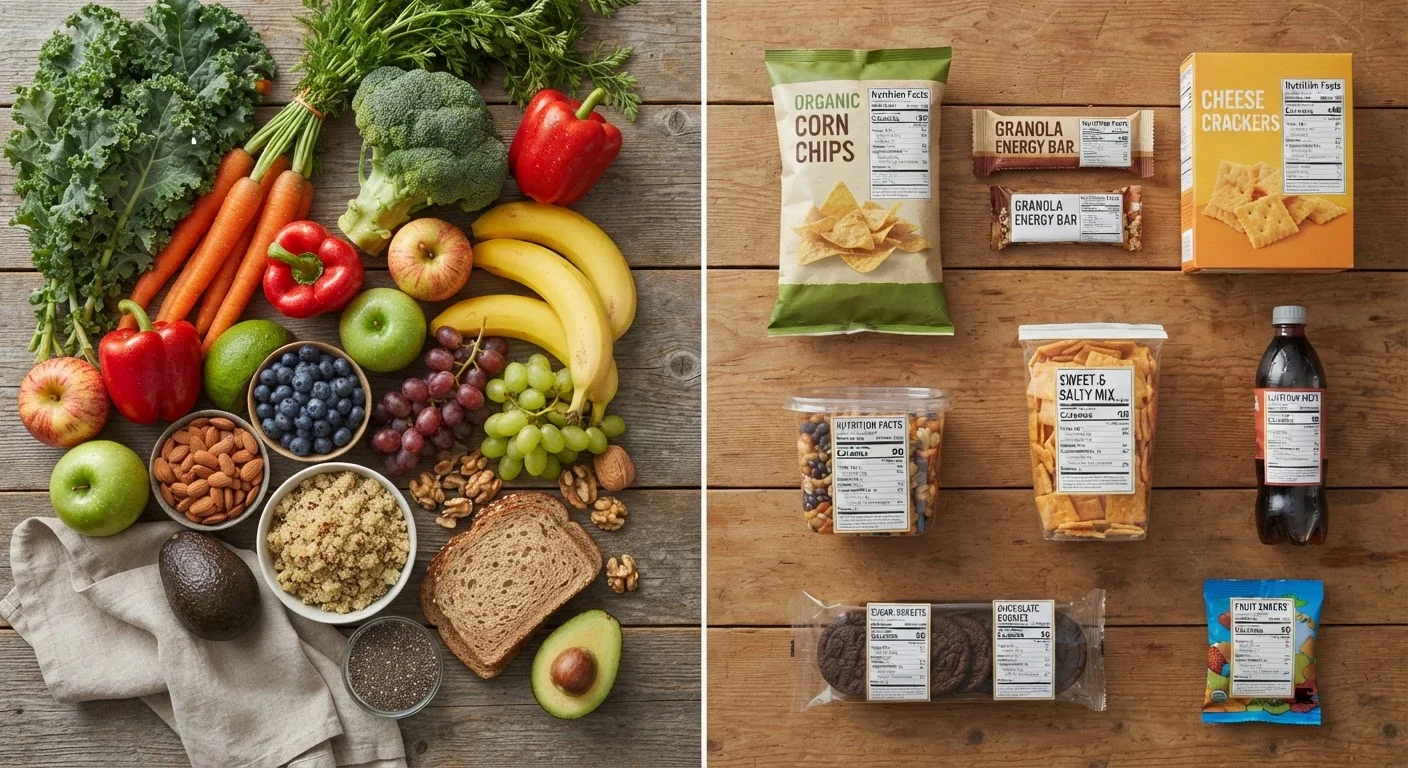
Whole foods
Foods closest to their natural state, with little or no processing.
Best for: Families who want to build long-term eating habits around nutrient density and ingredient simplicity.
Option B
Processed foods
Foods altered from their original form, ranging from mildly to heavily modified.
Best for: Busy households that rely on convenience, though the degree of processing matters significantly for nutrition.
If your goal is maximizing nutrient density on a budget
Whole foods
Staples like dried legumes, oats, and fresh or frozen produce deliver substantial fiber, vitamins, and minerals at a low per-serving cost.
If time is your biggest constraint on weeknights
Processed foods (minimally processed)
Options like canned tomatoes, frozen vegetables, and plain yogurt preserve most nutritional value while cutting prep time significantly.
If you are trying to reduce added sugar and sodium intake
Whole foods
Whole foods contain naturally occurring sugars and minerals without the added salt and sweeteners common in packaged products.
If you are navigating a tight grocery budget with picky eaters
Processed foods (minimally processed)
Strategically chosen minimally processed items like frozen fruit, canned fish, and whole grain bread can stretch a grocery budget while keeping meals varied.
What 'whole' and 'processed' actually mean
The word 'processed' appears on ingredient lists, social media posts, and nutrition guidance so often that it has lost much of its meaning. Technically, any food that has been washed, cut, cooked, canned, frozen, or fermented has been processed. That puts frozen spinach, pasteurized milk, and bagged salad greens in the same category as cheese puffs and packaged pastries, which is not useful.
Nutrition researchers use a classification system called NOVA, developed at the University of Sao Paulo, to sort foods by the extent and purpose of their processing. The four groups range from unprocessed or minimally processed foods (fresh fruit, plain meat, eggs) through culinary ingredients (flour, oil, salt) and processed foods (canned vegetables, cheese, cured meats) to ultra-processed foods (soft drinks, packaged snacks, reconstituted meat products). The distinction between Group 3 and Group 4 is where most of the health conversation sits.
A whole food, in everyday use, means something close to its original agricultural form with no or minimal added ingredients. An apple is a whole food; apple juice with added sugar and natural flavoring is not. This framing helps families think in practical terms rather than treating 'processed' as a single label that condemns everything in a package.
For more on how food myths muddy these definitions, see our breakdown of common nutrition misconceptions.
How the nutritional profiles compare
Whole foods tend to retain their original fiber, micronutrients, and phytocompounds (plant-based chemicals with biological activity) because minimal handling preserves cell structure. A cup of cooked brown rice keeps its bran layer, which carries fiber and B vitamins. The same amount of instant white rice has had that layer removed, leaving primarily starch.
| Criterion | Whole foods | Processed foods |
|---|---|---|
| Fiber content | Generally high; cell structure intact | Often reduced, especially in ultra-processed |
| Added sugars | None; only naturally occurring sugars | Common in packaged and sweetened products |
| Sodium levels | Naturally low | Can be very high in canned or packaged items |
| Micronutrients | Retained from original food source | May be reduced; sometimes added back artificially |
| Convenience | Requires more prep time | Ready to eat or quick to prepare |
| Shelf life | Shorter; fresh foods spoil faster | Longer; preservatives extend storage |
| Cost per serving | Varies; staples like legumes and oats are low-cost | Varies; ultra-processed snacks can be expensive |
Ultra-processed foods are formulated with combinations of refined ingredients and additives designed to extend shelf life, improve texture, and increase palatability. The result is typically a product higher in added sugar, sodium, and refined fat, with less fiber per serving. A 2019 randomized controlled trial published in Cell Metabolism by Kevin Hall and colleagues at the National Institutes of Health found that participants assigned an ultra-processed diet consumed significantly more calories per day than those on an unprocessed diet, even when both groups had equal access to food and equal hunger ratings at baseline. This was a small, short-term study, and results do not directly translate to every individual, but it is one of the more controlled data points available on the topic.
Minimally processed whole foods such as plain canned beans, frozen peas, and low-sodium canned fish retain most of their nutritional value through processing. Families do not need to avoid these; they are practical, affordable options that fit a nutrient-aware diet.
Reading labels without getting lost
Front-of-package claims like 'natural,' 'multigrain,' or 'made with real fruit' are marketing terms with no strict regulatory definition under current U.S. FDA rules. They do not reliably indicate how processed a product is. The ingredient list is more useful.
A short ingredient list where you recognize every item generally signals less processing. Seeing added sugars (listed under multiple names: high-fructose corn syrup, cane sugar, maltose, dextrose) early in the list, or seeing a long sequence of emulsifiers, colorings, and flavor compounds, signals heavier processing. The Nutrition Facts panel is required to show added sugars separately from total sugars, which helps distinguish a naturally sweet food from one with sweeteners added during manufacturing.
When 'processed' can still mean nutritious
Frozen vegetables are picked at peak ripeness and frozen quickly, which preserves most vitamins. Plain canned tomatoes, sardines, and kidney beans are processed but carry real nutritional value. The category of processed food is broad enough to include both nutritious staples and heavily reformulated products. Checking the ingredient list tells you more than the processing category alone.
Sodium is another number worth checking. The American Heart Association advises limiting sodium to 2,300 mg per day for most adults, with 1,500 mg as an ideal for those managing blood pressure. A single serving of some canned soups or packaged seasoning mixes can carry more than half that daily amount. Rinsing canned legumes under water removes a meaningful portion of added sodium without discarding the nutritional content of the food itself.
Making practical choices for your household
A diet built primarily around whole and minimally processed foods is generally consistent with current dietary guidance, but the goal does not have to be perfection. Families working with constrained budgets and limited cooking time can use a tiered approach: anchor meals around whole food staples (oats, eggs, legumes, fresh or frozen vegetables, fruit), fill gaps with minimally processed options (plain yogurt, canned fish, frozen edamame), and treat heavily processed items as occasional rather than daily choices.
Cooking from scratch more often is one of the most direct ways to shift toward whole foods without dramatically increasing spending. Our comparison of home cooking and meal kits examines how different preparation approaches affect nutrition and time for families.
Grocery budgets shape what ends up on the table as much as nutrition knowledge does. Understanding where your household money goes can help you allocate more intentionally toward food quality. Our household budget guide walks through how families can map their spending and find flexibility.
This article is for general informational purposes only and is not medical or dietary advice. Consult a registered dietitian or qualified healthcare professional before making significant changes to your diet, particularly if you are managing a health condition.