

Key Takeaways
Start here
Why raised beds work for budget gardeners
Next
Choosing affordable materials
Then
Sizing your bed to cut costs
When you're ready
Mixing soil without overspending
Final step
Assembly basics and what tools you actually need
Why raised beds work for budget gardeners
Raised beds give you direct control over soil quality in a way that in-ground planting rarely does, especially if your yard has compacted clay, rocky ground, or poor drainage. Because the growing area is contained, you spend money improving only the soil your plants actually use rather than amending a large plot.
Water stays where roots need it, which can reduce how often you irrigate. Weeds from surrounding ground have a harder time moving in, so you spend less time pulling them. For families watching expenses, lower water use and less maintenance time translate to real savings over a season.
The initial cost is manageable. A single 4-by-8-foot bed with a basic lumber frame and a DIY soil blend can come in well under $100, depending on material prices in your area. That figure drops further if you source reclaimed wood, use homemade compost, or already own basic tools. See our guide on renting versus buying tools if you need a drill or saw for this project but do not expect to use one regularly.
Choosing affordable materials
Lumber is the main cost. Untreated pine, Douglas fir, and spruce are the most widely available and least expensive options. Pine is the softest of the three and breaks down fastest, but it typically lasts three to five growing seasons before it needs replacement. That lifespan is long enough to make it a reasonable choice for a first bed.
Cedar and redwood resist decay longer, but they cost considerably more. If longevity matters to you and budget allows, cedar is worth considering for a second or third bed once you know the layout works for your space.
Standard dimensional lumber, such as 2x6 or 2x8 boards, builds a sturdy single-course wall without requiring any special cutting. Two 8-foot boards and two 4-foot boards form a complete rectangle. Ask the lumber yard to make any cuts if you lack a saw at home, as many will cut for free or a small fee.
Alternatives to new lumber include concrete blocks, galvanized steel landscape edging, or reclaimed wood from demolished structures. Each has trade-offs. Concrete blocks are heavy but last indefinitely. Reclaimed wood is inexpensive but may carry paint or chemical residue, so inspect it carefully before use in a food garden.
Sizing your bed to cut costs
Width matters more than length when it comes to usability. A bed no wider than 4 feet lets you reach the center from either side without stepping in and compacting the soil. Length can extend as far as your space and budget allow, but 8 feet is a practical limit before the structure needs a center support to prevent bowing.
Standard lumber comes in 8-foot lengths, so a 4-by-8-foot bed uses boards with no cuts at all: two boards go on the long sides and two on the short sides. This eliminates waste and saves time. Cutting lumber to odd dimensions means offcuts that often go unused.
Height affects how much soil you buy, which is where the real cost variation happens. A single course of 2x8 lumber sits about 7.25 inches tall. That depth works for lettuce, herbs, and most annual vegetables. A double course, stacking two boards on each side, reaches roughly 14 inches and suits deep-rooted crops, but it doubles your soil volume and therefore your soil cost. Start with a single course unless you have a specific reason to go deeper.
Mixing soil without overspending
Pre-blended raised bed mixes in bags are convenient but expensive per cubic foot. Mixing your own from bulk materials costs significantly less once you calculate how many bags you would otherwise need to fill a full-sized bed.
A simple, well-regarded formula uses one-third topsoil, one-third compost, and one-third coarse material such as perlite, coarse sand, or aged wood chips. This combination drains well, holds moisture between waterings, and provides enough organic matter for most vegetables without added fertilizer at planting time.
Topsoil and compost are available in bulk by the cubic yard at many garden centers and landscape supply yards, priced much lower per unit than bagged versions. A 4-by-8-foot bed that is 8 inches deep holds about 1.8 cubic yards of soil. That volume becomes expensive quickly in bags but is manageable in bulk.
Our companion article on compost versus bagged garden soil explains exactly what each component does and how to proportion them for different crops. If your household already generates kitchen scraps and yard waste, a simple compost bin can supply part of that one-third compost fraction at no cost over time.
Save money by sourcing bulk soil locally
Call landscape supply yards rather than relying solely on garden centers: prices for bulk topsoil and compost vary widely between suppliers in the same area. Some municipalities also offer free or low-cost compost made from yard waste collected during curbside pickup programs. Check your city or county website for availability.
Assembly basics and what tools you actually need
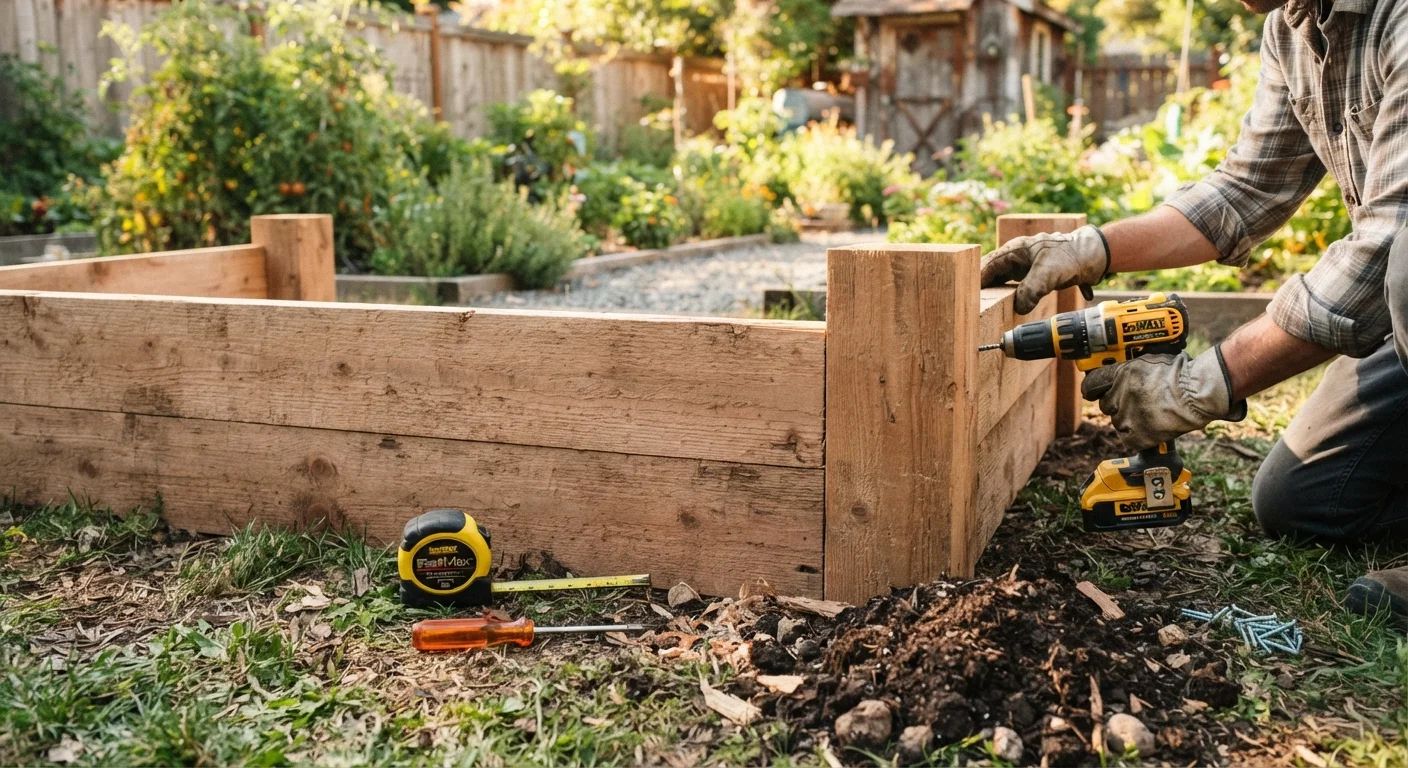
A basic raised bed requires only a drill and exterior-grade screws. Pre-drill holes near the ends of each board to prevent splitting, then drive two or three screws through the end board into the face of the adjacent board at each corner. That joint is enough for a small bed on level ground.
For a bed longer than 8 feet, add a center stake or internal brace on the long sides to keep boards from bowing outward as soil expands with moisture. A simple stake of 2x2 lumber driven into the ground at the midpoint and screwed to the board face does the job.
Level the ground before placing the frame. Unlevel beds allow water to pool at one end, which stresses plants and can rot the lower board faster. A few passes with a flat spade to remove high spots is usually enough. You do not need to excavate deeply; just remove surface irregularities.
Once placed, line the bottom with cardboard before adding soil. Cardboard blocks weeds from below, breaks down within a season, and costs nothing if you save shipping boxes. Avoid boxes with heavy ink coatings or plastic tape; remove tape before laying the cardboard.
If planning this project alongside other home expenses, the family budget starting point covers how to set aside small amounts for home and garden projects without disrupting household finances.