

Key Takeaways
What clogged gutters actually do to your home
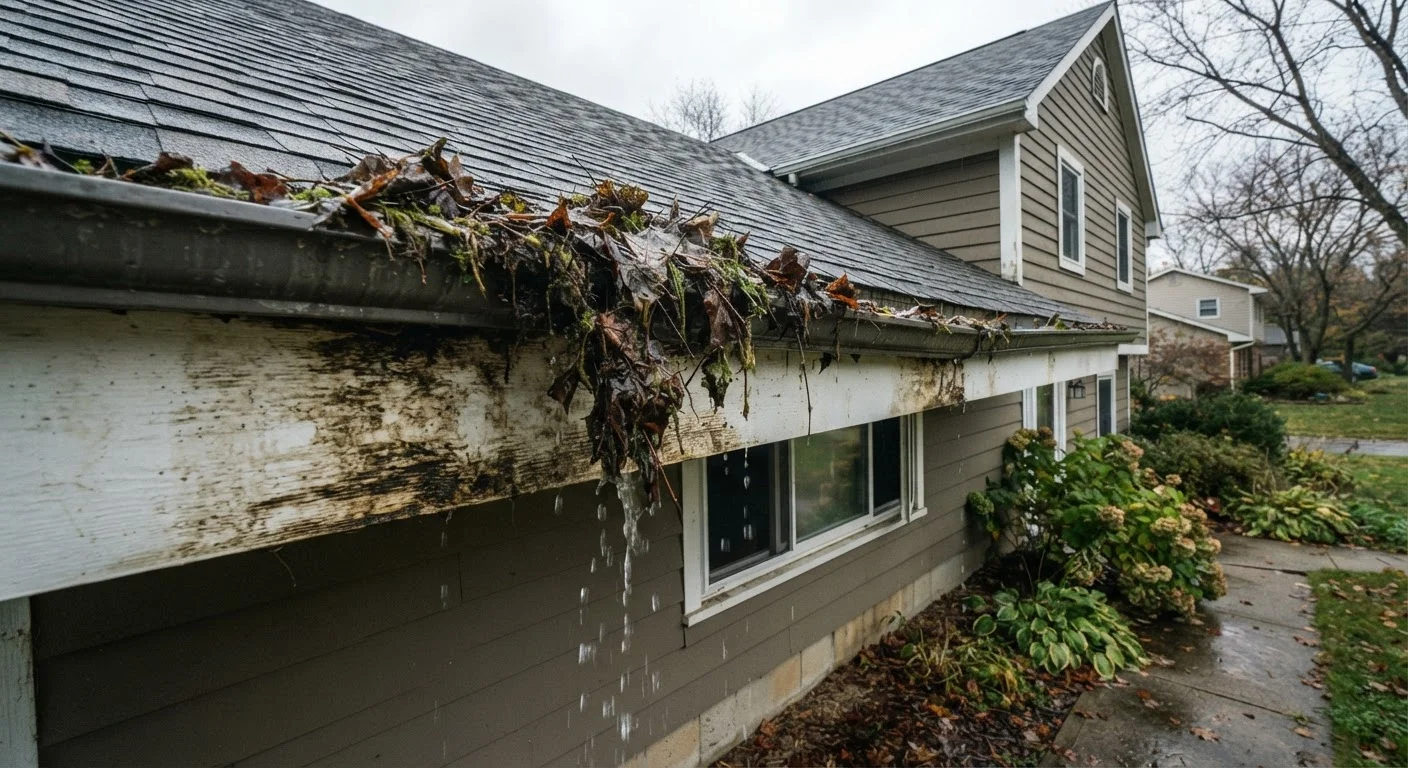
Gutters have one job: move rainwater off your roof and away from your home's structure. When leaves, seed pods, and shingle grit block that path, water backs up and finds new routes. Those routes almost always lead somewhere you do not want water to go.
The most immediate damage is to the fascia board, the horizontal trim your gutters are mounted to. Wood fascia sitting under standing water softens and rots. Replacing a single rotted fascia section can cost several hundred dollars once labor and matching trim are included, and the damage often spreads to the soffit (the material covering the eave underside) before anyone notices.
Water that overflows at the foundation level is a more serious problem. Soil that stays saturated against a foundation can push moisture through concrete block or poured walls, leading to basement seepage or crawl space mold. Foundation waterproofing repairs are among the more expensive home projects a family can face. The seasonal home maintenance calendar covers gutter cleaning alongside other tasks timed to prevent exactly this kind of compounding damage.
Ice dams are another consequence in cold climates. Debris-filled gutters hold meltwater that refreezes at the eave edge, forcing ice under shingles and into the roof deck. Roof deck replacement and interior ceiling repairs can run into the thousands.
Two-story and steep-roof gutters: hire a pro
Working on gutters above a single story significantly increases fall risk. A fall from two stories is frequently fatal or causes severe injury. If your gutters are on a second story or the roof pitch makes ladder placement unstable, the cost of a professional cleaning is far less than a hospital bill or a roofing repair done incorrectly. Always verify that a contractor carries current liability insurance and workers' compensation coverage before work begins.
Common mistakes homeowners make with gutter maintenance
Cleaning gutters only when they visibly overflow, rather than on a set schedule.
Why it happens: Gutters are out of sight, so most homeowners do not think about them until water spills over the edge during a rainstorm.
Using a leaf blower from the roof to clear debris without checking downspouts afterward.
Why it happens: Blowing debris out feels faster than scooping, and it is, but the displaced material often compacts inside downspout openings.
Ignoring gutter hangers that have pulled away from the fascia.
Why it happens: A slightly sagging gutter still carries water most of the time, so the gap between hanger and fascia does not seem urgent.
Standing on the top two rungs of a ladder to reach higher sections of the gutter.
Why it happens: Homeowners want to finish the job without repositioning the ladder, and the top rungs look close enough.
Assuming gutter guards eliminate the need for maintenance entirely.
Why it happens: Gutter guard packaging and marketing often imply that installation ends gutter cleaning for good.
As the scheduled maintenance vs. reactive repairs article shows, the pattern of skipping routine service and then absorbing a large repair bill applies just as much to your home's exterior as it does to a vehicle.
A safe DIY approach for single-story gutters
Cleaning single-story gutters is a reasonable DIY task if you follow a deliberate process. The work involves a ladder, so safety is not optional.
Start with a sturdy, properly rated ladder. An extension ladder or a multi-position ladder with standoff arms (which hold the ladder away from the gutter so you do not dent it or put weight on the fascia) is the right tool. Place the ladder on firm, level ground and have another person present to stabilize it. Never lean a ladder against the gutter itself.
Work in sections. Scoop debris into a bucket using a gutter scoop or a garden trowel, moving the ladder rather than reaching sideways. Overreaching is the most common cause of ladder falls during gutter work. Once debris is out, flush the gutter channel with a garden hose toward the downspout to clear fine sediment and check water flow. If water pools, the gutter may need to be re-pitched (a minor adjustment to the hanger brackets).
Check downspout flow by running the hose at the top opening. If water backs up, a clog is inside the downspout. A plumber's snake or a high-pressure nozzle attachment can clear most blockages. While you have the hose out, inspect the gutter seams and end caps for gaps, and press any loose hangers back into the fascia. Sealing small gaps with gutter sealant is a simple repair that prevents leaks at joints. This kind of small-scale sealing work is related to the broader principle in why caulking is an underrated energy-saving task: small gaps left unaddressed become larger, costlier problems.
$1,000-$5,000
Typical cost range for foundation waterproofing repairs
HomeAdvisor and similar estimating resources consistently place interior basement waterproofing in this range, with exterior excavation work running higher.
2x per year
Minimum recommended gutter cleaning frequency
The International Association of Certified Home Inspectors recommends cleaning gutters at least twice annually, with additional cleanings for homes near heavy tree cover.
$100-$250
Average professional gutter cleaning cost for a single-story home
Angi cost data places professional gutter cleaning for a standard single-story home in this range, making DIY a meaningful savings opportunity for capable homeowners.